


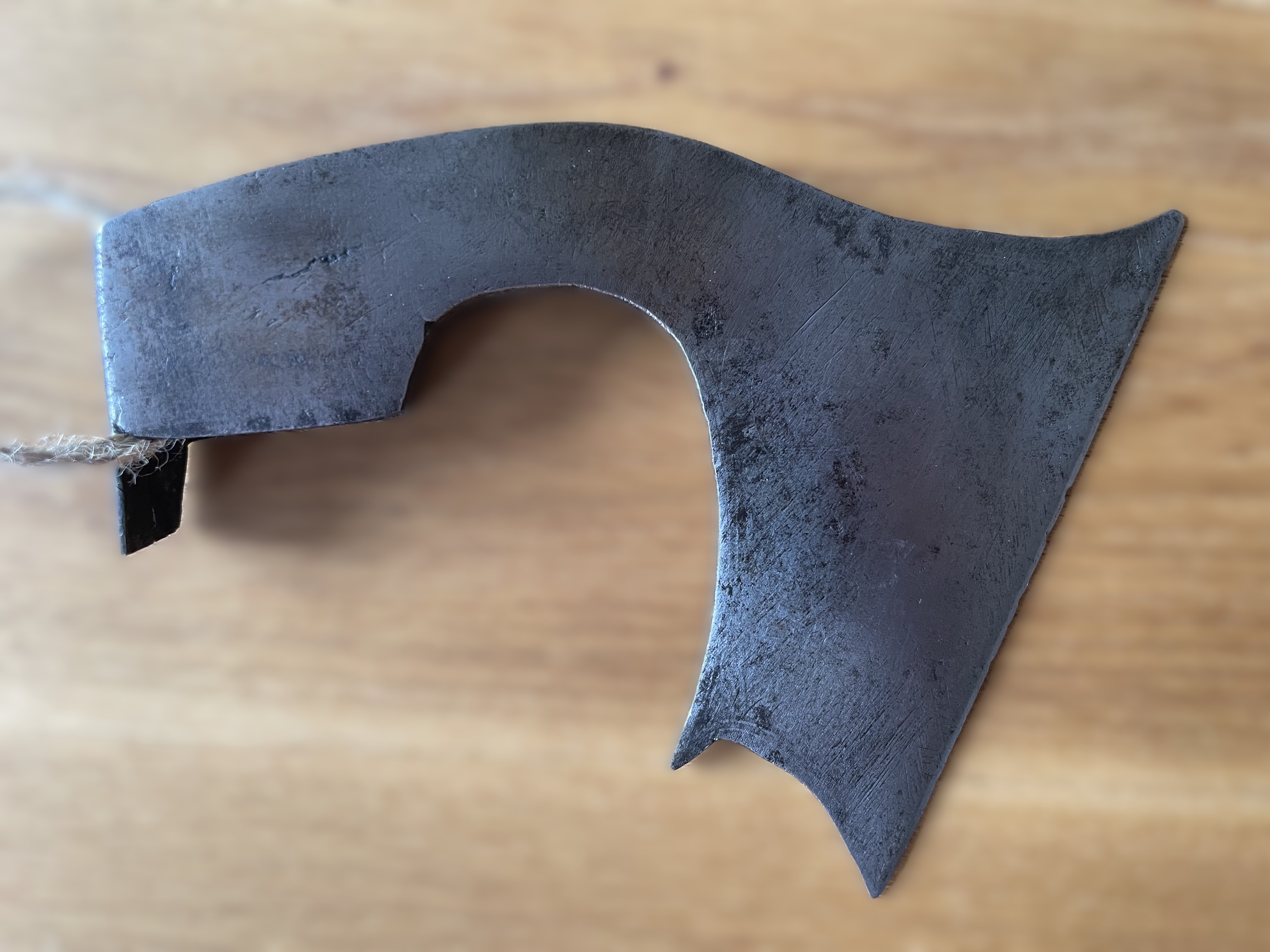
Among those interested in history, there is a large group of people who collect exclusively or mainly swords, firearms or armour, as well as a smaller part who cover the less ‘beloved’ fields. This applies to weapons such as hammers, spears, scythes, pikes, lances, throwing projectiles, Nadziaks or axes (we simply give these weapons the name noswonogus here, for “not swords, not guns”).
While there is a relatively colourful and vast landscape of literature on the main topics (swords, firearms, armour), noswonogus are often mentioned together somewhere in the margins. If you are lucky, you will find a book like the one by Tibor S. Kovacs (Maces, War-Hammers and Topors from Hungarian Collections) which is dedicated to this special topic and offers many illustrations. However, this type of literature is rare. Classical authors such as Wagner, Dziewanowski or Oakeshott treated the subject marginally.

Is the collector community’s disinterest in such weapons due to a lack of literature or is the lack of literature rather the result of a lack of interest? Both are probably true. However, I am quite sure of one thing: if there were more and better literature to provide an organised introduction to the subject and if it were easier to differentiate between clear types, more collectors would certainly devote themselves to this exciting, underestimated and rewarding subject. After all, there is still a great deal to discover, some of the objects are still available at very favourable prices and you have the opportunity to build up a collection that is clearly different from those of others.
For investment reasons alone, weapons that are neither swords nor firearms will be more worthwhile than swords in the future: the increasing digitalisation of unique objects (the first time they are put ‘online’ on the internet) only makes the prices higher with every sale, as every seller wants to compensate for inflation etc. in addition to any profit that may be made. This mechanism is of course the same for other weapons, but firstly on a smaller scale and secondly, the purchase of the many unresearched pieces at auctions and the subsequent research and categorisation of the pieces offers a large field of opportunities for profits on potential sales. This is hardly possible with a sabre model 1796 of the English light cavalry. For prices that were still being asked a few years ago for the best-preserved pieces of mentioned sabre pattern from the Dutch Rijksmuseum, you can get significantly worse examples at the present time.

Fashion naturally plays a major role in the price development of objects. But I am of the opinion that the prudent collector should see his collection not only as a product of collecting fashion or an accumulation of random things, but as an long-time investment. Only if you pursue a clever investment strategy when building up your collection will you have the chance to regularly sell certain pieces again, not only to make room for new ones, but also to get a substantial budget increase that does not allow the quality of the collection to stagnate, but exponentially raises it to new levels.
By an ‘investment strategy’ for collectors, I mean the classic diversification from financial investments on the one hand, but also the interweaving and inclusion of personal preferences, aesthetics and specialised knowledge on the other.
I explain: Diversification is clear, you shouldn’t have the same model of an object 10 times in your collection, because if you suddenly want to acquire something larger and sell five of them at the same time, the supply on the market increases at that time and this in turn lowers the price.
Personal preferences are of course the foundation of a collection, but they should also take non-emotional calculation into account. You should at least have an idea of how the collection should develop over a few years. If you don’t have that, you run the risk of making random purchases on a whim that will later have a negative impact on the eventual sale value. By the aesthetics of a collection, I mean the selection of objects that best reflect what the collection should represent. In my opinion, if you can, you should buy fewer but higher quality artefacts. Every artefact from the past has its raison d’être and deserves attention. But all too often I see collectors and their collections including everything that is cheap at auction and then hanging them chaotically on the wall. If you like it, that’s ok, but it has little to do with a scientific-historical approach or clever investing.

It’s one thing if someone deliberately collects completely corroded infantry sabres from the 19th century – if they stay the course and the line, then that’s a nice thing. But if you mix everything up and only buy the cheapest, you can expect to make a loss and, sadly, the collection will probably not develop into what it could be.
For me, specialised knowledge at this point is certainly not knowing the latest details from the CV of Mr Prosser from London, but acquiring knowledge from the areas of collecting that could fit into your own collection, but are not the main subject (e.g. swords) and, above all, of which you can see that other collectors are not or only slightly interested in. Only then do you have a chance of getting the rarities at a reasonable price on the open market.
This is where the noswonogus come into play again. You regularly see auctions at which battle hammers, axes or other polearms are sold, sometimes in really good condition, for a fraction of the price of swords of comparable conservation and rarity. To put it simply: from a historical time x and historical region x, the sword is always more expensive than the axe, staff or hammer. Completely unjustified! There are several reasons why noswonogus are a perfect addition to the collection portfolio.
- rarely was a sword or firearm actually the primary sign of a commander. It was often regiments, axes or maces. If you want to get closer to history and the turmoil of battle, these officers’ insignia are very attractive.
- for visual-aesthetic reasons, a display case or a wall on which various items from a region or an era are displayed is more ‘exciting’. Of course, this is a matter of taste.
- the educational aspect of a collection is of course much more complete if you can show more than just one type of object. A holistic collection emphasises different groups of exhibits that are interrelated.
- I have already mentioned the cost factor. Noswonogus are currently much cheaper than swords, armour or firearms.
- room for own research. Many types of weapons are currently still very poorly researched. If you want to make a name for yourself in the blank weapon expert community, research and write about these weapons. We don’t need the tenth book on Lichtenauer and the longsword or the katana at this moment – nothing against these swords of course.

Of course, there are also disadvantages to venturing into a less described area. There is a greater risk of misclassifying and categorising individual objects. It could be that my thesis of increasing demand will not apply at all in the future and you will be able to sell your items for less (although I doubt that). To be fair, in my opinion the market for sword collectors (also as investors) is currently much more toxic than what the noswonogus have to offer. There are significantly more forgeries of swords on the market than of other weapons. These fakes are almost always much more expensive. The best example is the infamous Viking swords. So if you are not sure about buying a sword, you should of course not take any risks with other weapons. But for those who have already taken their first steps, alternatives offer an immense opportunity for enrichment (not only in a financial sense!).
It is still difficult to get to grips with such topics on other weapons, for example many forums are strictly in favour of one topic and delete posts about anything that deviates from the topic. Nevertheless, there are still a few possibilities for research and it is safer to exchange information on general forums. The others will follow suit. After all, this is also cultural heritage and should not be neglected. As a small contribution to this, I will personally try to present such noswonogus in the Glad from time to time.
In an occupation such as collecting blank weapons, I would like to encourage every fellow collector to see his collection as an investment and to treat and manage it as such. I am convinced that this can not only be an individual and personal enrichment, but that the community of collectors will also benefit from it.


Leave a Reply