


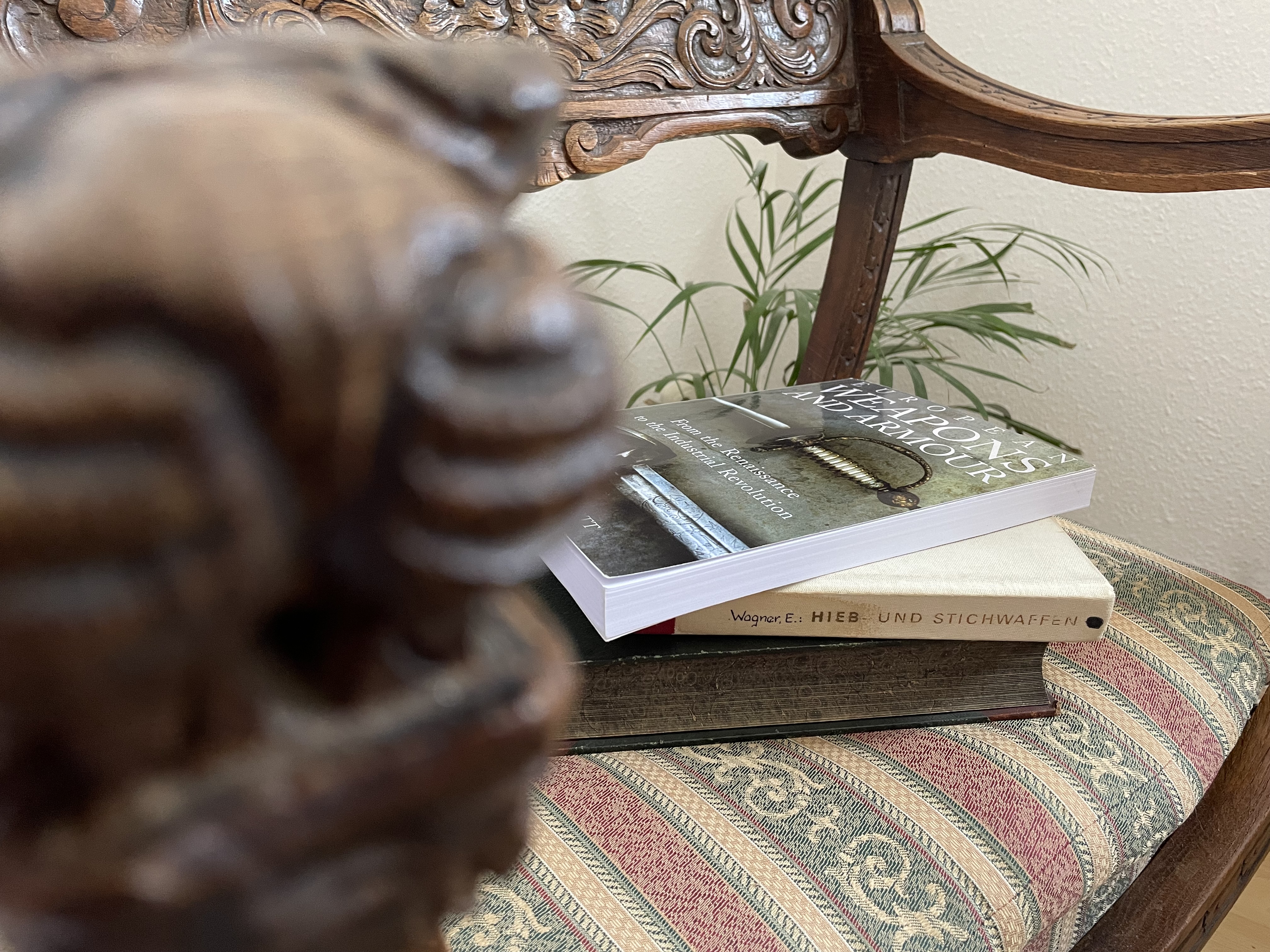
This article introduces a new format to our magazine: The Pro Series.
The purpose of this series is to discuss old and new questions, current problems and the market for historical weapons with people who are professionally involved in the subject. This should make it easier for new collectors to get an idea about certain topics and experienced colleagues will hopefully enjoy the insights into possibly different points of view.
We are delighted to have been able to discuss the thesis of the importance of literature about historic arms and armour with Matthew Forde.
Matthew Forde is a professional writer with a passion for historical arms and armour. He has a website, a page on Patreon and has written the only English Language resource on Italian swords.
- Dear Matthew, thank you for taking your time to do this interview. The first question is rather personal: What was your first book on historical weapons and what is your all-time favourite book on the subject?
I had to search my memory for this answer but I am almost certain that my first dedicated book on historical arms and armour was Weapon by DK Books, edited by the late, great Richard Holmes. It was one of those general books on the subject, covering a lot of cultures and eras, with many great photographs to flick through. I think I gave it away to a friend as I became more specialised but it was perfect for anyone with a general interest in the subject.
- How many books about historical arms and armour (including magazines etc.) do you personally own?
I have had to downsize due to house-moves so my library is smaller than it was but I‘ve had hundreds of books, magazines, auction catalogues and pamphlets over the years—and I probably have around a hundred now. I‘d love more space to build an old-fashioned study and fill it with reference books, and historical knick-knacks.

- What comes first in the life of a collector: the first antique sword or the first book about swords?
That‘s a tough question! I‘d say the book as they are cheaper and more easily found. The first sword is certainly a gateway to more books, though. And more swords!
- Are there any standard works that you think every collector of historical swords must own?
There are books that are required reading for every category so I can‘t list them all here, but certainly.
- What should a valuable book about swords include?
Above all else: accuracy. Sadly, there are several mainstream books out there that are riddled with basic errors. Being a copywriter, I see the mistakes in them more than the general reader might, and it pains me. I would much rather an author write ‘I don‘t know’ regarding an aspect of a sword, or words to that effect, than guess or present hearsay as fact.

- What do you prefer: good photographs of objects or beautifully painted or drawn graphics (e.g. á la Petard).
Both have their own merits but, as I write factually on the subject, I prefer photographic sources as they leave less to interpretation.
- As in every field of science, new findings are also emerging in archaeology and history. If you buy a book from 30 years ago, it is certainly out of date in some respects. How do you keep your knowledge up to date? Do you read current scientific papers or certain magazines about historical weapons?
This is very true, and many of the go-to books on certain subjects are pretty old at this point and our global knowledge pool has increased, outdating previously relevant sources. For instance, Lord Egerton‘s important work on Indian arms and armour is from the very late 1800s. Furthermore, you can see a clear change in the quality of information in books since the proliferation of the internet as, suddenly, research bacome subjected to wider peer review and authors gained access to many more sources.
- What do you think about the development of the market for books on historical swords: do we have enough up-to-date literature or are we lagging behind?
I think we are lagging behind on some topics and that‘s something I‘d like to change. Collectors focus more on reading social media groups now, where other collectors congregate, many of whom have superb knowledge that can be shared in easy ways. However, this seems to have not translated into more books from experts, and posts and trheads can‘t be searched as well as the old forums, which would be a boon to research.
- The vast majority of collectors have a core area on which they focus. How essential is it for collectors of British sabres, for example, to read books about Austro-Hungarian weapons and vice versa?
It is important, and also difficult. One of my areas of knowledge focuses on the Italian swords of the 1800s, designs which took influence (or copied exactly) swords from other countries in Europe, France and Austria in particular, so it was helpful to be able to spot those areas of martial cross-over. It can be hard, though, as some sword designs were so widely used that gaining the necessarily comprehensive knowledge would require a significant amount of studying.

- Are there any areas of “gladiology” (our editorial team’s new favourite term) that you completely miss in the available literature? In other words, is there the right literature for every collector?
There are still large gaps, alas. Speaking for my own niche, there was no English language book available on Italian 19th century swords at all, before my work was published, and we still don‘t have any specific ones on the swords of the pre-unification states, the Papal States, the navies, and the post-1900 Kingdom of Italy.
- Would you say that once you reach a certain level of experience, you should throw your reference literature out of the cabinet because it is no longer useful?
Definitely not. Just speaking for myself, I have a poor memory so I don‘t mentally retain the information in books very well, so I really do need them on the bookshelf or on the PC to refer to. When people ask me questions on my own subject, I often still have to look through my book to find the answer.

- Rules always make life easier for us collectors and we like them, even though they rarely apply one-to-one to certain situations. Do you think there is a certain price ratio between objects in the collection and the appropriate library of a collector? An imaginary example: The library should always be 10% of the total market value of the collection.
You‘ve hit the nail on the head—ten percent of the collection‘s value should always be spent on books. At least, that is the old adage I was told by veteran sword collectors. Few books are cheap in this field, meaning it‘s hard to get a really good reference under, say, £30. Collectors should expect to pay around £100 for an important text but this high price can make people reluctant to do so, even though they buy swords for many hundreds and, sometimes, thousands of pounds. However, reference material is invaluable and it not only makes you appreciate your collection more but it saves you money in the long run by aiding the dodging of undesirable additions such as fakes.
- Is there an insider tip (a particular book) that you would like to share with the readers of the magazine?
There are too many books to mention, really, and they are all subject-dependant, but I would encourage readers to gravitate towards books published by the larger museums like The Metropolitan and the Royal Armouries; and to look at Bezdek, Elgood, Robson, Dellar—all are good authors to start with. It really is dependant on your favoured niche.
- What would you like to see from a magazine like “THE GLADIOLOGICAL” in terms of approach or content in the future?
I think you‘re already doing a great job so just keep going!
The interview was conducted in writing. Shown images are not linked to Mr. Forde. The questions were asked by Patrick Anthony Skura.
You can find Matthew Forde´s website here.
You can buy Matthew Forde´s book about Italian and Sardinian arms “la Sciabola” here.


Leave a Reply