

by Miguel Seguí Sabater
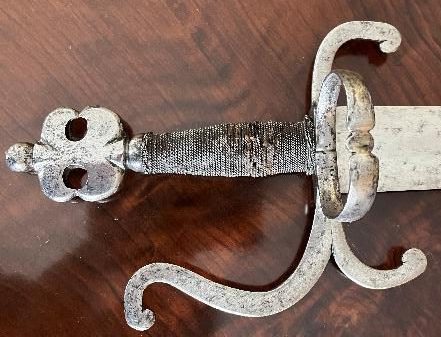
In this article, I wish to analyze a sword with a very uncommon shape that has been part of my collection for some years. The piece measures 96 cm in total length, the blade is 81 cm long, has both sides marked, and features a rounded tip.

The typology of this sword is quite unusual, as the lack of a pointed tip is typically found in short infantry swords such as the Katzbalger. The Katzbalger was widely used by Landsknecht mercenaries during the 16th century and is characterized by its broad, straight blade and distinctive S-shaped guard. These swords were optimized for close combat in the chaotic environment of battlefield melee, where thrusting was less effective due to dense formations. Their robust design allowed for powerful slashing strikes, making them ideal for breaking through enemy lines. However, what makes this particular piece remarkable is that, unlike a Katzbalger, it has the length of a cavalry weapon, making it an anomaly within traditional classifications.

The shape of the sword suggests an origin in southern Germany or Austria, so I began looking for similar pieces in the museums of this region. I was surprised to find a significant number of identical swords displayed at the Heeresgeschichtliches Museum (HGM) in Vienna, where they are classified as “Haudegen, 16. Jh” (slashing swords, 16th century).
Seeking further background information, I contacted the museum, but their response was limited (translated):
“The 17th-century Haudegen you requested are on loan from the Graz State Armory. Unfortunately, we do not have any further information on the origin of these edged weapons.”
When I reached out directly to the Graz State Armory, they had no records of these swords, nor were they aware that they had been loaned to the HGM.

Continuing my research, I found identical pieces in the State Historical Museum in Moscow (SHM), where they are classified as “Palash”. This difference in classification does not necessarily indicate that these weapons belonged to different military contexts, but rather that their unusual characteristics make them difficult to categorize.

A valuable source that provides further insights into this type of weapon is the article “A 16th Century ‘Styrian’ Riding Sword in the Collections of the History Museum of Moldavia in Iași” by Cătălin Hriban. This study examines a similar sword and presents arguments for its use by light cavalry. Hriban notes that while its form deviates from traditional cavalry swords, its blunt tip suggests that it was primarily intended for slashing rather than thrusting, aligning with the tactics of light cavalry units during the late 16th and early 17th centuries. He also highlights that Styrian sword-making traditions influenced the development of various Central European cavalry weapons, reinforcing the idea that these swords were optimized for mounted combat.

Beyond its possible use by light cavalry, my further analysis suggests that this sword was most likely an arsenal weapon, produced in large numbers to equip local militia forces. During the 16th and 17th centuries, Graz was a strategic military center of the Habsburg Monarchy, facing repeated incursions by Ottoman forces. The city’s defenses relied heavily on improvised militia units, which required large quantities of affordable, easy-to-use weapons.
The characteristics of this sword align perfectly with those of mass-produced arsenal weapons:
- Lack of a sharp tip → Easier and cheaper to produce, while still effective for slashing attacks.
- Relatively simple hilt design → Prioritizing functionality over elaborate craftsmanship.
- Standardized form → Facilitating rapid training and deployment of militia troops.

It is well documented that similar weapons were issued to Austrian and Styrian militia units defending against Turkish raids. Unlike professional cavalry weapons, these swords were intended for quickly equipping citizen-soldiers, many of whom lacked formal training in swordsmanship. The focus on slashing rather than thrusting made them effective in skirmishes and ambushes, which were common tactics used in the defense of frontier settlements.
To fully understand the purpose and significance of this sword, it is essential to place it within the historical context of the region. During the 16th and 17th centuries, Central Europe was the scene of numerous conflicts between the Habsburg Monarchy and the Ottoman Empire. Graz, as the capital of Styria, played a crucial role in the defense of the Habsburg eastern frontiers.
In 1379, Graz became the residence of the Habsburgs when it was designated the capital of Inner Austria (Innerösterreich), which included Styria, Carinthia, Carniola, and some Italian possessions. The imperial family remained in Graz until 1619. During this period, especially in the late 16th century, the city faced multiple invasion threats from Ottoman forces. Graz was frequently raided by the Ottoman army, making it a vital military stronghold.
One of the most significant conflicts was the Long Turkish War (1593-1606), which pitted Emperor Rudolf II and the Prince of Transylvania Sigismund Báthory against the Ottomans. This war, also known as the Fifteen Years War, consisted of a series of military campaigns primarily fought in present-day Hungary and surrounding regions. The prolonged conflict strained the resources of both empires and further reinforced the importance of well-armed frontier militias.
An interesting visual reference for this type of sword appears in the painting “Scènes de pillage après la bataille”, attributed to Sebastian Vrancx and Pieter Brueghel the Younger. The artwork, dated to the early 17th century, depicts a chaotic battlefield with extensive cavalry presence. In the foreground, among the scattered weapons and armor, a sword with a similar form—featuring a rounded tip—can be seen lying on the ground.

This artistic representation is significant because it visually confirms the presence of such swords in a military context. The fact that this scene includes light cavalry units further supports the hypothesis that these weapons were used in fast-moving, mobile warfare rather than in heavy cavalry charges or static infantry engagements.

This Styrian sword remains an enigmatic piece due to its uncommon typology. While its length suggests cavalry use, its blunt tip is a feature more associated with infantry weapons like the Katzbalger. The presence of similar swords in Austrian and Russian collections, combined with their ambiguous classifications (Haudegen, Palash), indicates that they likely served multiple roles in different military contexts.
The most plausible explanation is that these swords were arsenal weapons, designed for rapidly equipping local militias in Graz and other Styrian territories to counter the Ottoman threat. Their mass production, simple design, and functional efficiency suggest they were used by defensive forces rather than professional cavalry. Further research, including metallurgical analysis and detailed archival study, could shed more light on the exact origins and military use of these fascinating weapons.


Leave a Reply