

All good things come in threes! We have selected a special exhibit for our third sabre of the month.
It is special in that it is a beautiful piece to demonstrate several things: Cultural connections, evolution of design, importance of swords as diplomatic gifts and differences in supposedly unique pieces.
We won’t be able to present and elaborate on all the points here in detail, but we think it’s a great opportunity for interested readers to do further research – it’s worth it! We list suitable reading at the end of the article.
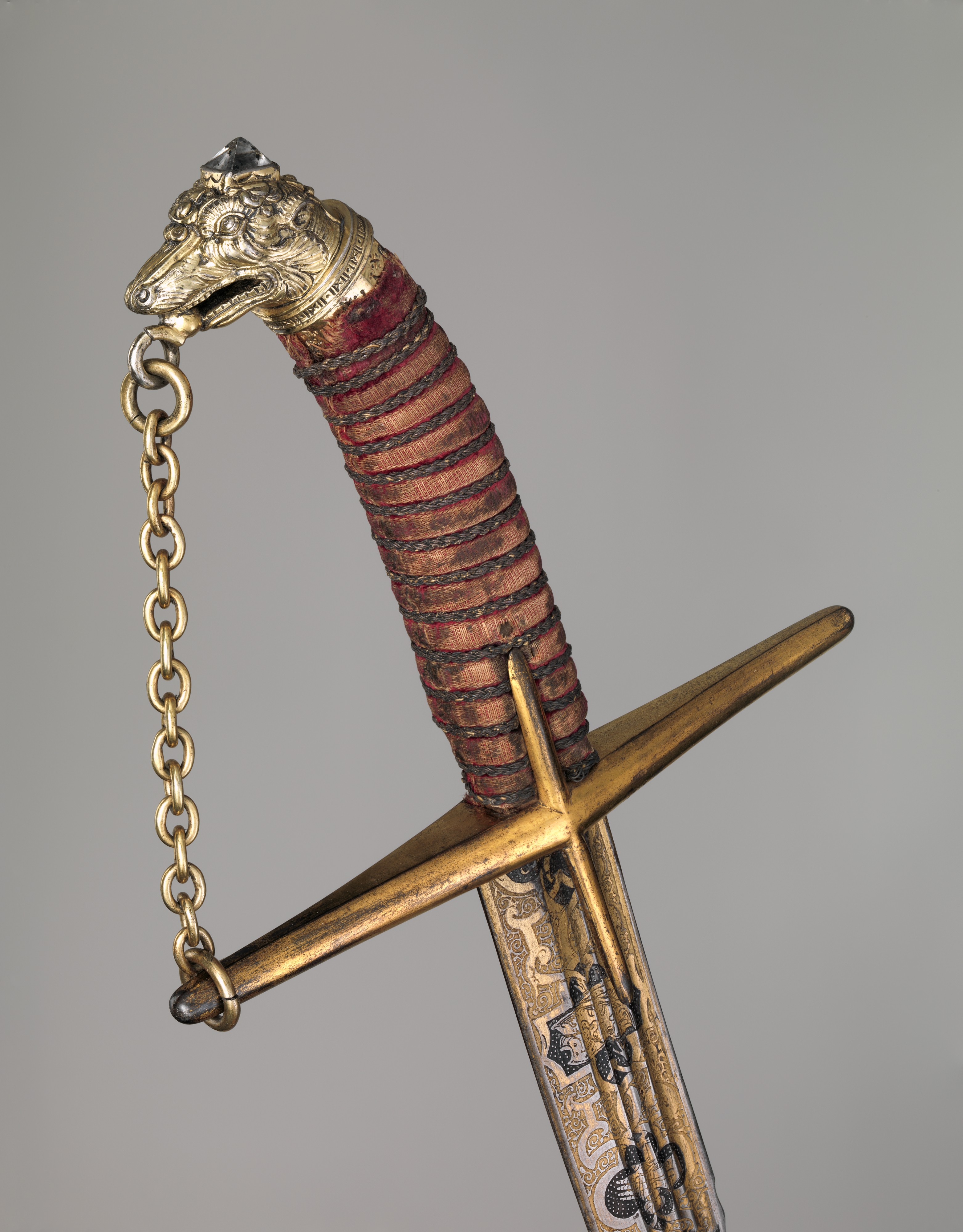
So, the sword of the month for July 2024 is a Polish-Hungarian sabre from the end of the 16th century, currently hosted at the Metropolitan Museum of Art in New York (MET). At this point we would like to thank the MET for allowing the use of their photographs without a license.

Total lenght 95,2 cm
Blade lenght 80 cm
Sabre weight 936 g
Steel, gold, silver, leather, wood, textile, semiprecious stones
Let´s begin
The special feature of this sword: It differs from the known standard types in that it has an animal head instead of the usual “almond” as a pommel and this is connected to the crossguard by a small chain. With this combination, you might think that this is a unique piece – completely wrong! A series of almost identical sabres (probably 12 pieces) were produced, some of which can be seen in museums in the USA and Europe. Looking at the available provenance, those sabres most probable belonged to the Saxon court after being gifted. This specimen came into possesion of known expert and collector Bashford Dean who bought it from descendants of the Wettin family in the early 20th century, before it came to the MET.
Cultural connections
Stefan Batory, a Transylvanian prince, ascended to the Polish throne in 1576, following the turbulent period of the Jagiellonian dynasty’s end. His reign, which lasted until 1586, marked a significant phase in Polish history, particularly in terms of military reforms and territorial defense. Batory’s political maneuvering stabilized the monarchy and united the nobility under his rule.
One of Batory’s most notable contributions was his military reform. Understanding the need for a robust military to defend against external threats, he reorganized the Polish army. He was so successful that the Polish-Lithuanian nobility, which was still very much part of the canon of the rest of Europe in terms of clothing, armour and weaponry, was increasingly influenced by Hungarian styles. He gave a definitive turn in this direction to a process that had been underway since around 1500, as troop types such as the hussars had been known in Poland-Lithuania long before Batory. Sabres like this one mark this important time.
High-ranking nobles gave each other richly decorated and high-quality sabres of this type as a sign of appreciation and recognition. At the same time, such gifts were intended to symbolize that one was a person of culture and in tune with the times: one was following fashion. It did not take long for the new fashion for Hungarian sabres to spread from the elite to the masses, and soon ordinary soldiers could also be seen with Hungarian sabres, although usually without an elaborate animal head and made of simple steel without complex work.

The interesting thing about these highly decorated sabres: you might think that after being given away, they hung unused on the wall in some private armory and gathered dust. In fact, it is said that such sabres were often used in competitions (often on horseback) and were even issued to troops in times of war hundreds of years later (see Holger Schuckelt, die Türkische Cammer, page 55). While the crossguards, pommels and blades often remained the same, the chains and fabrics were constantly renewed up until the 19th century (in this example, a new chain is documented in 1687). One could not wish for more evidence of the constant appreciation in cross-cultural terms, because many other weapons were neglected and perished with time.
But not only Poland-Lithuania and Hungary, but also vast regions, kingdoms, counties and other spheres of influence used sabres of this type: Roughly speaking, the region of use at the end of the 16th/beginning of the 17th century can be narrowed down to the Baltic states in the north, Saxony in the west, the Bosporus in the south and the Muscovites in the east.

Evolution of design
The typical Hungarian blade design is used in these sabres and is probably at the apex of its rise: for the next roundabout 100 years, blades of this type will dominate the European sabre landscape and continue to determine the patterns well into the 19th century. This hilt and grip also mark the beginning of the classic European sabre. The grip bent towards the cutting edge with an abutment for the fingers and the chain that first turns into an L-shaped crossguard and finally forms the closed knucklebow are important elements in the evolution of the European sabre. The aforementioned “almond pommel” will become the standard for sabres 200 years later during the Napoleonic era. This is a very big topic in its own right: THE GLADIOLOGICAL will publish an extra-long article in the future about the evolution of the typical “hussar sabre”.

But it is not only the functional elements that can be placed in the context of ongoing development. The decoration using animal heads in this kind of “realistic manner”, the specific gold-plated and blued blade at the highest level is also typical of the 16th century. The etched motifs are strongly reminiscent of the then fashionable Transylvanian style – a child of its time. Many other weapons such as axes, war hammers and swords were also decorated in this way and exported to remote regions.
In summary, it can be said that with sabres of this type, European handles, processing methods and techniques ultimately meet blade designs that have their origins in the Orient. Above all the kingdoms of Hungary and Poland, as then-biggest neighbours of the Ottoman Empire (we recommend a look at historical maps!), adapted these designs, combined them with European traditions and thus paved the way for the classic European “hussar sabre”.

Diplomatic gifts
Sabres of this type (with and without animal pommels) were often given as gifts by nobles across Europe for generations. One example is a similar sabre from the same period in the Dresden Armory (inventory number Y 104) which Elector August received as a Christmas present and which has been in the same armory ever since.
The origins of this tradition with these specific sabres, if you can call it a tradition, lie with Batory himself. During his lifetime, the monarch gave away many of these weapons, often with his image, titles and name in gold on the blade, as diplomatic gifts. Without there being any concrete evidence for this, one can assume that the MET sabre could also be a gift sabre from Batory. The style of the decorations and of course the weapon itself are at least very similar.

At this point we would like to point out that of course not all blades with Batory’s image were made during his lifetime. A real trend must have grown out of these gift sabres. One can assume that many wanted to show off such a blade, imitated this habitus and it is proven that historically younger blades were also decorated in this way (the so called Batorówki).
We know that sabers of this type were resold in the 17th century for around 35-40 thalers. A thaler was 20-30 grams of pure silver, depending on time and place.
The tradition of swords as diplomatic gifts is of course much older and widespread throughout Europe. The most famous are probably the huge papal swords of honour, which cannot be surpassed in terms of craftsmanship.
Unique or one of many?
Let’s be honest: If you see this sabre for the first time, for example at an auction or in a museum, you would not think that there are several of them. However, as mentioned at the beginning, the MET reports 12 documented pieces.
We were able to locate another two specimen in the Polish National Museum in Krakow (MNK). Relatively at the beginning of the current arms and armour exhibition in Wawel Castle, you can see one of them, which has to make do without blade decoration, but is in no way inferior to the example in the MET (Wojciech Zabłocki describes it in Cięcia prawdziwą szablą, object 95, page 305). Another one can be found in the online archive of the MNK.
The MET speciment appears to carry the “GH” mark of Georg Hoffmann (according to the museum), a goldsmith active in Wrocław between 1586 and 1609.

Nonetheless, these seemingly identical sabres illustrate how sword makers approached the matter at that time – despite the common design, no two swords will be even remotely identical. One gets the very strong impression that this is not the consequence of incompetence, but rather a matter of aesthetics, of something special and of a conviction that is probably somewhat alien to “modern man”. This is a big difference to most swords of the 19th century, without wishing to diminish their value here.

What is interesting about the three pieces is that, according to the descriptions, the Polish examples seem to not bear the mark of the Wrocław goldsmith, but do have the well-known sickle marks on the blade, which the MET specimen in turn is missing. These marks can be dated and styled to northern Italy; a Styrian or Hungarian origin would be too early for these sabres.

Whether a sword maker received a delivery of different blades and worked on them or whether different masters accepted this order is difficult to trace today. What is also known about other sabres of this type is that the gilding and blueing of the blades was often commissioned in Gdańsk. In summary, we can therefore assume that the blades came from Genoa/Northern Italy, that the decoration of the blades took place in Gdańsk and that the setting of the blade (hilt and grip) and the scabbard elements (often made by the same craftsman) took place in Wrocław.

Of course, this is just the theory of ours (the Glad´s editors) based on what is known about this kind of swords, but it beautifully illustrates the role that international trade routes played for a product.
Finally
We hope you enjoyed this joint excursion into the exciting history behind this international sabre and that we have inspired you to do further research on Central and Eastern European sabres!
We would be delighted if you contact us and tell us your opinion! Use the contact form on our main page or write directly to thegladiologicalinstitute@gmail.com!

Further Reading
- Die Türckische Cammer: Sammlung orientalischer Kunst in der kurfürstlich-sächsischen Rüstkammer Dresden: Sammlung orientalischer Kunst in der … Ausstellung im Residenzschloss Dresden, 2010
- Wojciech Zabłocki, Cięcia prawdziwą szablą, 1989
Sources
- https://www.metmuseum.org/art/collection/search/33998
- Specimen in the MNK: https://zbiory.mnk.pl/pl/wyniki-wyszukiwania/katalog/46717
- THE GLADIOLOGICAL image database
- Die Türckische Cammer: Sammlung orientalischer Kunst in der kurfürstlich-sächsischen Rüstkammer Dresden: Sammlung orientalischer Kunst in der … Ausstellung im Residenzschloss Dresden, 2010
- Wojciech Zabłocki, Cięcia prawdziwą szablą, 1989


You must be logged in to post a comment.