

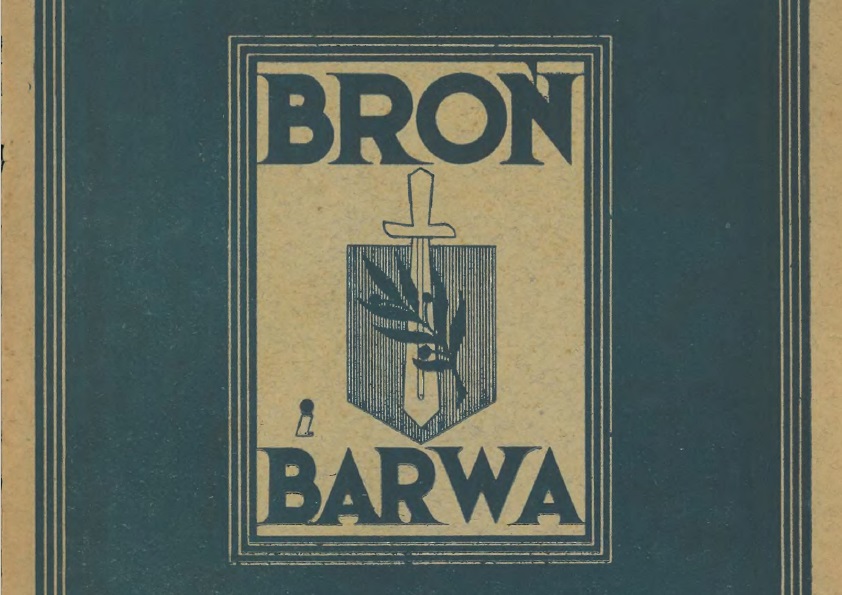
In the 1930s, the Stowarzyszenie Przyjaciół Muzeum Wojska (Society of the army museum friends) founded the Broń i barwa (Arms and uniforms) magazine. It existed until 1939.
The founding members were numerous forefathers of specialists in historical weapons and uniforms in Poland, including people such as Stanisław Meyer, Bronisław Gembarzewski and Władysław Dziewanowski, to name but a few.
The original editions of those times are currently almost impossible to obtain in physical form (our editorial team is pleased to have added some of the issues to our library), but fortunately the editions have all been digitised. What seems even more important here is the fact that we are allowed to make the articles available to you on a licence-free basis. The original is in Polish – we have translated it carefully for you.
We would like to take this opportunity to emphasise once again how important we find academic collaboration in the field of historical weaponry and are proud to be able to republish a magazine like Broń i barwa. We hope and are sure that this is also very much in the interests of the authors of the time. We dedicate this translated version to these people.
Selected articles from Broń i barwa will appear regularly in THE GLADIOLOGICAL. A world premiere!
YEAR I – JUNE 1934 – No. 1
TO THE READER
The first issue of ‘Arms and Uniforms’ leaves the printing press. It represents the first attempt at a Polish magazine dedicated to military museology, and thus (fills a serious gap in our military-historical press. Other nations have long had publications of this kind, e.g. the ‘Zeitschrift für historische Waffenkunde’, the ‘Passepoil’, the ‘Carnet de la Sabrefache’, the publications of the Society of Friends of the Army Museum in Paris etc.
The purpose of the journal is clear. The aim is not only to facilitate scholarly work in the field of military museology, but above all to unite the efforts of people working in this field on their own. It is also about bringing together people who have a passion for the great past of the Polish Army and are connected with it either through their own work or through a name that has become famous in the history of the Polish military.
We are concerned with the entire past of the Polish Army, from its earliest times to its earliest days, and all of this constitutes the field of work outlined for our magazine.
We hope that this first attempt will be gratefully received by wide sections of Polish society, which after all cannot be indifferent to the great wartime past of our chivalrous Nation.
Tadeusz Różycki
(Edit: Graduate colonel of infantry of the Polish Army, military historian)
Marshal Piłsudski’s sabre
written by CZESŁAW JARNUSZKIEWICZ.
(Edit: Brigadier General of the Polish Army, participant of World War I and II, Chairman of the Board of the Brest-on-Bug District of the Association of Polish Legionaries in the years 1936-1938)
Officials of the Polish Ministry of Foreign Affairs presented the Marshal on his name day with a beautiful old Polish sabre, from the former collection of the King of Bavaria.
The sabre is of the Hungarian type, very common in Poland in the 17th century, and has a blade of damascened steel, not crystalline, but cupped. The hilt is gold, covered with an exceptionally beautiful fine unlacquered ornament. The blade, 79 cm long, 3.3 cm wide at the base and 3.6 cm wide at the feather (edit: Polish for the Yelman), has a curvature of 4.5 cm. The pattern of the scrolls of the damast is non-uniform: dense and tangled on 2/3 of the length of the blade passes into diagonal striations on the blade. The cross-section of the blade concave-ground on both sides and provided with a single fuller running along the back points to the second half of the 17th century. The feather is very long with a pronounced hammer.
On the ricasso inlaid in gold is a bust of the king, whose features are reminiscent of John III (edit: Sobieski). On the reverse, a coat of arms of the Batory family using the same technique. The bust and coat of arms surrounded by laurel wreaths.
Along the spine a gold inscription: ‘STEPHANUS BATHOREUS REX POLONIAE PRINCEPS TRANSILVANIAE’. Besides, on both sides of the blade, also inlaid with gold, features reminiscent of 16th and 17th century Italian characters: two semicircles facing each other with their backs and a number of circles, 3 and 4 each. On both sides of the bust and the coat of arms, one gold crescent with human features. On the hammer on each side a small gold ornament. At the hilt, an engraved but illegible Italian-type hallmark.
The hilt is a cross, with long langets, without a thumb-ring, iron covered with gold plate with small, dense unlacquered ornamentation. The handle shaft of wood wrapped with gold wire.
The pommel flat, strongly forward, in the shape of a very elongated almond, gold, covered with ornament like a hilt. The scabbard wooden, covered with black leather, has only three fittings of the same workmanship as the pommel. The lower one, very long, with a window. The shape of the window cut-out in its lower part indicates the end of the 17th century.
The whole sabre bears the marks of long wear. Upon examination, we conclude that the sabre dates from the second half of the 17th century. This is indicated by the cross-section of the blade and the shape of the window in the (edit: scabbard´s) lower ferrule. The name of King Stephen does not indicate the age of the sabre, as we know numerous specimens of ‘Batorówki’ dating from the 17th or even 18th century. The head may be of Italian workmanship, made for Poland, or by an Italian master working for us or one of his disciples, which would explain the Italian character of the markings.


You must be logged in to post a comment.